I got a keyboard when I was five. My sister, Meera, had started taking piano lessons and, being the younger sister I was, I had to do everything she did. But instead of paying a teacher for lessons for me as well, my parents commissioned my sister to pass on her knowledge.
The keyboard was one of the cheaper ones, plastic keys with a stand. My sister played on the actual piano, but my fingers were too small and weak to press down on the heavy keys. I don’t remember how I felt in those initial days playing. I don’t remember if I liked it, I don’t know if I found it hard. I’m sure I took great pleasure in sharing something with my sister.
At some point, the keyboard broke. It was fixable, but it would take a bit. So I temporarily transitioned to using the piano.
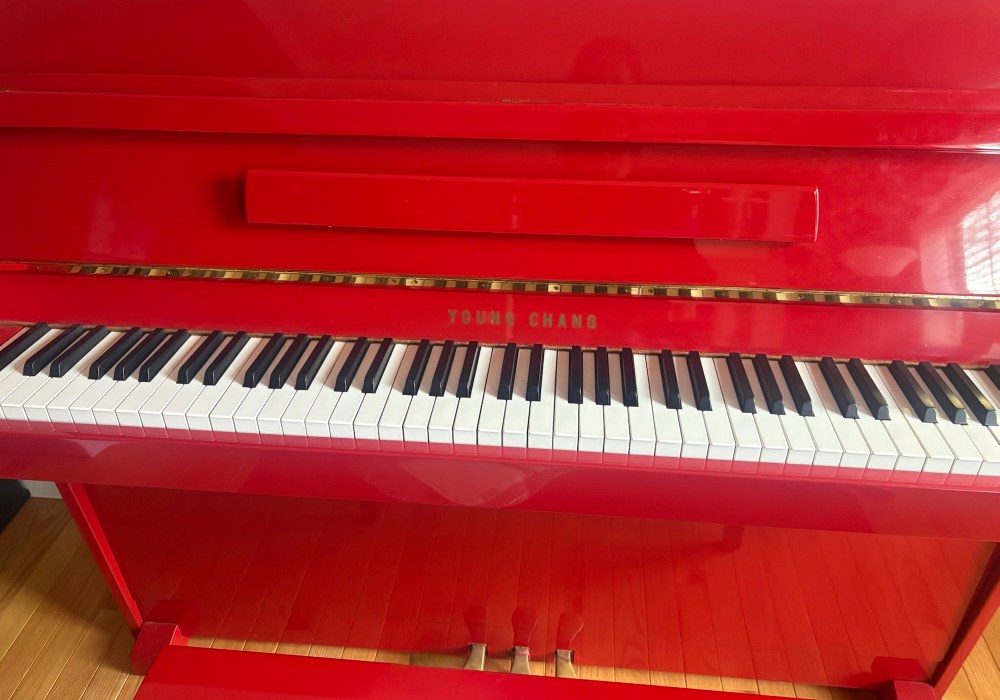
This piano was beautiful. It was bright red, so unique and so specially ours. In our home in Austin, it was wedged in the corner of the master bedroom, between the queen-sized bed and the dark wood dresser. The keys still have slight marks from the adhesive of the sticky notes Meera put on them to help me identify the notes. And there’s a little green mark on the edge of one of the keys from when I decided to play too soon after painting my nails.
Standard pianos have 88 keys, 52 white keys and 36 black. This piano was special in many ways, including the number of keys it had: 50 white and 35 black, giving it 3 less keys than expected. Those 85 keys hold so many memories of fingers trying to hit notes and missing, of new chords discovered, of new songs being successfully played and the celebrations that followed. Those keys have played Mozart and Beethoven, Schwartz and Swift, Cohen and Williams.
When I started playing on it, I struggled to get my weak little fingers to press the keys. I hadn’t realized real piano keys had weight to them. But it was fun playing a real piano with real golden pedals (I had no idea what they were for) and a real piano bench that stored all the music books.
Eventually, the keyboard got fixed. When I went back to playing on it, I discovered I was pressing the keys with too much force. My hands and fingers had adapted to the actual piano and had gotten stronger, too strong for the plastic keys of the keyboard. It seemed the keyboard was no longer necessary.
As I grew older, it became clear I had large hands and long fingers. My mom called them an artist’s hands, and I took pride in that. Did the size of them match my height? Absolutely not. But I loved that it meant my hands were made for playing piano and easily hitting octaves.
This beautiful red piano travelled with us across the country when we moved to Albany in 2011. My dad almost sold it, but we luckily convinced him not to. At this point, Meera had stopped taking lessons and would only play occasionally for pleasure. I, on the other hand, loved it. I found most kids in school practiced their instruments out of necessity and force, but I loved playing. It was a break between schoolwork and doctor’s appointments. I could play for hours if it didn’t bother others. I would get lost in the music and in the pleasure that this was the one good thing I was good at.
I remember watching one of my friends who had played for years, who was way better than I was, as she could just sight-read a new piece of music, essentially seeing the notes for the first time and able to play it. I was so jealous. I wanted to be able to do that.
I eventually started finding free sheet music online for popular songs and began learning to play those. Later on, I would buy piano books of my favorite soundtracks and albums and artists. I would spend hours pretending to be on stage with Idina Menzel and Kristin Chenoweth, singing the songs of Wicked. Or I would be in the recording studio with Taylor Swift and Ed Sheeran, singing the songs that made them famous and playing the notes along with them.
My mom says she loved hearing me play. When I used to not be so good, she would shut the door so she didn’t have to hear me (very rude). But eventually I got better, and she enjoyed having the door open so she could listen to me play. I hated playing for others, even my family. I was so self-conscious, I didn’t want others hearing me practice or play. I would get so anxious before piano recitals, and then would fully black out while playing.
When I went to college, I worried about how I wouldn’t get to play every single day. Turns out I was too stressed to actually have time to remember I loved playing. But my sophomore year, I lived in a dorm that had a piano in the basement, next to the laundry room. Whenever it wasn’t occupied, I tried to play and sing along to help relieve stress.
By this point, I could sight-read fairly well. I could play almost any song I wanted, not perfectly, but I could get through it and sing along if that’s what I wanted. My skills had developed so much that I could recognize patterns and chords and play songs on the fly. To this day, this is still one of the things I’m most proud of. I love being able to pick up a new sheet of music and roughly play it.
When I moved to Seattle after graduating, I realized I really wouldn’t have a piano to play on, and I was going to miss the red one. At least on school breaks, I got to go home and play (and the whole year I spent at home due to the pandemic). A year after moving, my mom suggested I get an electric piano. It still had keys that felt like an actual piano, and it was structured like an actual piano, it was just smaller and plugged into the wall. So I still got to play and be free even across the country.
In January, my parents sold the red piano. I’m going to miss it so much. I’m going to miss going home, walking through the front door and seeing it in the study room directly to the right. That study room had four walls painted red. My mom had to paint the far wall white so the red piano wouldn’t clash. It was sold to a piano teacher, so I hope whichever students play on it experience the same joy I did, the joy of playing such a beautiful instrument.
I’m going to miss playing on the very first piano I ever played on. I learned how to read music there and how to play my first classical songs. I even gave my mom some (short-lived) introductory lessons, and went back and helped my sister relearn how to play (also only for one session). I learned how to feel through music and became confident enough to share my playing with the world. I learned how to be free on that beautifully bright red piano.
 Words for Thought